

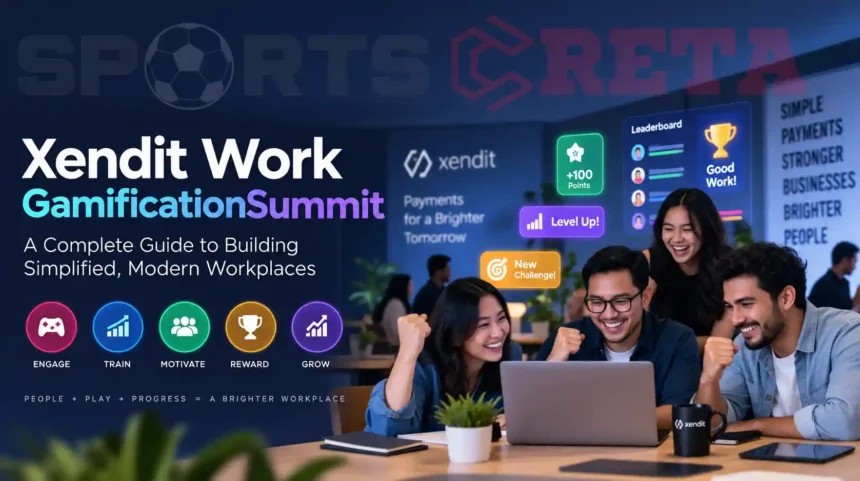
Workplace gamification adds a sense of playfulness to routine activities. Instead of relying on conventional training programs, performance tracking, and employee motivation schemes, organizations can introduce such game-like elements as points, challenges, progress trackers, badges, rewards, and leaderboards. The Xendit Work Gamification Summit brings the principles of gamification to the fintech world. The summit explores ways to implement game design, behavioral psychology, and clear objectives in routine work.
Among the topics discussed at the summit are employee engagement, onboarding, productivity, training, product design, and operations. Xendit is a financial technology company offering financial and payment solutions. Such services offered by the company include payment acceptance, payouts, platform payments, financing, and other financial tools for businesses. Keep reading further for a detailed guide on Xendit Work GamificationSummit.
What Is Xendit Work GamificationSummit?
Xendit Work Gamification Summit emphasizes using game design principles in a professional environment. The key concept behind Xendit Work Gamification Summit is the transformation of routine workplace tasks into interactive activities with set objectives. The structure of the summit combines lectures, workshops, hands-on training sessions, demonstrations, and case studies.
Participants can get insights into implementing gamification strategies in employee engagement, product development, operations, education, and client interaction. The strategy prioritizes simple game elements over complex game mechanisms. Teams can select one business objective, incorporate several elements of game mechanics, and observe the results.
Understanding Xendit & Its Business Practices
Xendit is a fintech company that allows businesses to collect payments and transfer money. The platform integrates various payment systems in Southeast Asia and has APIs and no-code solutions for financial operations. Xendit takes care of payment acceptance, payment links, subscriptions, platform payments, payouts, financing, and other financial infrastructure.
The company also provides automated transaction processing and reconciliation services. In addition, Xendit has payout infrastructure that allows sending funds from businesses to bank accounts and e-wallets. These services are helpful in such cases as rewards, incentivization, reimbursements, or other transactions.
What Is The Concept of Workplace Gamification?
The term “workplace gamification” implies adding some game-like elements to non-game activities. Of course, the aim is not only to entertain workers but also to motivate them and help them see their progress with the help of interactive ideas. For instance, companies reward their employees with points for completing training modules, use progress bars in order to monitor onboarding processes, etc.
They can even use challenges to encourage collaboration. Studies show that gamification has different effects depending on its application. In particular, a 2024 paper published in the Journal of Workplace Learning identified variables associated with workplace gamification and proved the connection between effective gamification, engagement, and organizational commitment.
History of Gamification Summit Meetings & Xendit Work GamificationSummit
At first, gamification meant applying gaming principles in contexts not related to games. Gabe Zichermann was one of the pioneers of gamification, being the GSummit chairperson. In 2011, GSummit New York gathered the representatives of gamification.
Gabe Zichermann represented himself as the gamification guru and GSummit chairperson. These summits contributed to the popularization of discussions of game ideas, human behavior, motivation, and engagement in the workplace.
Core Mechanisms of Xendit Work GamificationSummit
The Xendit Work GamificationSummit involves the following game mechanics:
- Points: Having a points system will represent progress. Individuals and/or groups earn points upon completing certain tasks.
- Progress bar: It represents the distance from the target. It is used for long processes such as onboarding and training.
- Badges: These badges can reflect certain achievements. Badges can be earned upon completion of a security training course or certain skills.
- Leaderboards: They involve comparing participants or teams. A clear set of rules should be established in order for healthy competition to promote the main idea.
- Challenges: Help highlight short-term goals. Teams complete individual tasks or shared ones.
- Feedback: Immediate feedback helps to show employees how close they are to the target.
3 Psychological Pillars of Xendit Work GamificationSummit
Self-determination theory is another concept applied in gamification in organizations. According to this theory, there are three basic human needs that include autonomy, competence, and relatedness. Autonomy refers to choice and control. Gamified platforms for training provide autonomy since employees have a choice to select their learning path.
Competence is the need for improvement and mastery of skills through levels, milestones, feedback, and skill challenges. Relatedness means the need for connecting with other people. Team challenges, peer recognition, and group missions enhance social interactions among people. Recent studies on gamification of human resource management have linked these three needs to intrinsic motivation and engagement of the employees.
Gamification For Employee Onboarding
Employee onboarding is one of the most practical cases for implementing gamification at work since new hires are tasked with lots of activities. The gamified onboarding process will allow dividing all required activities into smaller missions. This will include company introductions, product training, compliance modules, quiz games, and other team-based activities through the progress bar.
The latter will provide an employee with the ability to track completed and pending tasks and will also make the management aware of the level of participation. The described Xendit model of gamification uses small achievements and simple next steps rather than advanced game models.
Xendit Work GamificationSummit – Interactive Employee Training
Another gamified activity can be an interactive training that does not involve any lengthy document or lecture but includes learning via interactive challenges. For example, compliance training can include scenario-based questions where employees choose one of the variants of the answer and get feedback from the program. Sales representatives can use role-playing activities to practice talking to customers. The same goes for customer service employees, who will complete simulated situations and will receive feedback about their performance. Gamification and Artificial Intelligence in Simulated Workplace Challenges
Artificial intelligence will increase the efficiency of gamified training because of its ability to create highly realistic simulations. Client-facing representatives like sales representatives and customer service employees can practice their conversation skills without involving real customers. The AI-driven simulator will show an objection or issue; the employee will respond to it, receive feedback, and then repeat the situation once again. Thus, gamification can be combined with adaptive learning, which allows gradually increasing complexity of the situation.
Leaderboards and Friendly Competition By Xendit Work GamificationSummit
Leaderboards are one of the most recognizable elements of gamification. It can be used to show individual, departmental, and team-level progress. For example, one can launch a short-term challenge focused on completion of some training sessions. Employees will earn points for completing specific modules, and there will be a leaderboard showing the progress of each team. Nevertheless, the study shows that individual game mechanics do not necessarily boost the motivation to perform specific actions in the same way for everyone.
The experimental study showed that game mechanics influence psychological needs in different ways: badges, leaderboards, and performance graphs mostly affected competence and autonomy in particular cases, whereas avatars, storytelling, and teamwork impacted relatedness. Thus, companies should choose mechanics depending on the behavior they want to promote.
Reported Xendit Work GamificationSummit Results
Tests performed in the summit report are presented concerning work and product tests associated with Xendit. Some of the pilots included a progress bar, points system, and surprise credits. According to the report, such experimentation increased onboarding completion by 14%, while reducing support handling time by 11%.
Another test covered repeat transactions and credit redemption, which resulted in a 6% increase in repeat transactions for six weeks. The strategy of testing was oriented toward small tests rather than major ones. The teams were assessing each change, observing key metrics, getting feedback, and scaling successful solutions.
Conclusion
Xendit Work GamificationSummit focuses on applying game design concepts in modern workplaces. Challenges, progression, rewards, feedback, teamwork, and goals define its structure. Gamification can be applied in various spheres such as onboarding, education, customer interactions, product development, and operational processes. Studies prove that efficient gamification at work fulfills the needs of autonomy, competence, and relatedness of employees. There is one key lesson for businesses here – gamification should have a specific goal for every gaming component.
FAQs
What Is Xendit Work Gamification Summit?
This is about the application of gaming concepts in the workplace, in relation to Xendit and the Gamification Summit.
What is gamification in the workplace?
The process of applying game-related components to workplace activities.
What are the components of gamification?
Components include Points, Badges, Leaderboards, Feedback, Progress Tracking, Challenges, and Rewards.
Also read: Digvesh Rathi Age, Career, Family, Stats and Net Worth (2026)